
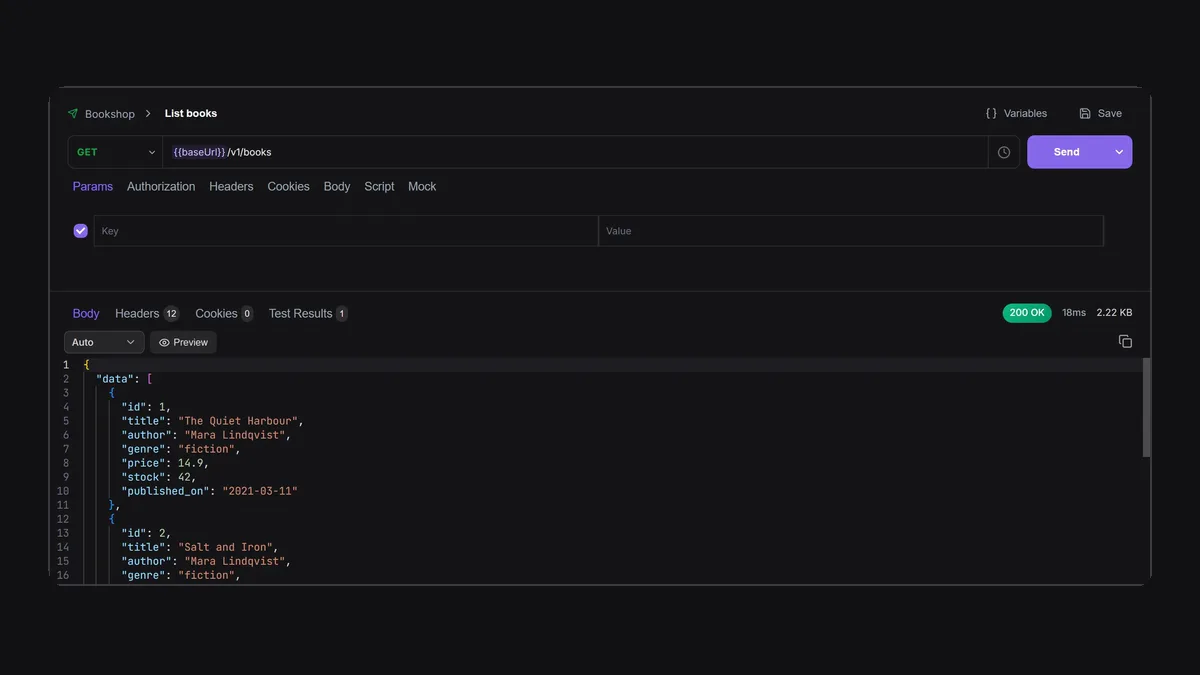
Yaak and Bruno are the two API clients people reach for when they leave the cloud-first tools. Both run offline, need no account, and keep your requests on your own machine. Both are open source. So the choice comes down to details that matter a lot once you use them at work: the licence, the file format, and how a team shares collections.
Everything below was checked against Yaak’s and Bruno’s own sites, docs and changelogs in September 2026.
At a glance
Yaak first, then Bruno.
- Made by — Yaak: Gregory Schier, who created Insomnia. Bruno: Anoop M D and the Bruno team, launched in 2022.
- Licence — Yaak: MIT source since September 2024; the signed builds need a licence for work use. Bruno: MIT open-source edition; paid Pro and Ultimate tiers add features.
- Price — Yaak: free for personal use; $79 a year or $399 lifetime for an individual at work; $149 per user per year for a business. Bruno: open-source edition free for everyone; Pro $6 and Ultimate $11 per user/month billed annually.
- Protocols — Yaak: REST, GraphQL, gRPC, WebSocket, SSE. Bruno: REST, GraphQL, gRPC, WebSocket, SSE, SOAP.
- Storage — Yaak: local app data, with workspaces you can mirror to a folder for Git. Bruno: the collection is the folder, plain-text files (YAML by default since v3.1, .bru supported).
- Secrets — Yaak: encrypted in the operating system’s keychain. Bruno: .env files; secret managers on Ultimate.
- Extras — Yaak: plugin system, CLI, imports Postman, Insomnia, OpenAPI, Swagger and cURL. Bruno: CLI for CI, mock servers, imports Postman, Insomnia, OpenAPI and WSDL.
Licence and price: the biggest practical difference
Bruno’s open-source edition is free for any use, including at work, and the paid tiers add conveniences: native Git integration and an AI assistant in Pro; the in-app Git UI, secret-manager integrations, SSO and audit logs in Ultimate. The one-time Golden Edition has been discontinued; existing licences stay valid.
Yaak takes a different route. Its source code is MIT-licensed, but the prebuilt, signed app asks for a licence when you use it at work. Personal projects are free, and there is a 30-day trial. For a solo freelancer that is $79 a year; for a five-person team on the business plan it is $745 a year. That is a fair price for a well-made tool, but it means “open source” does not mean “free at the office” here.
Files and Git: folder-first vs app-first
Bruno is folder-first. The collection is a directory of text files, one per request, designed to be committed and reviewed. Opening a teammate’s branch is opening a folder. That makes code review of API changes natural, and it is Bruno’s defining idea.
Yaak is app-first. Workspaces live in the app, and you can switch on mirroring to a directory so a Git repository sees them as files. The day-to-day feel is closer to Insomnia: fast, keyboard-friendly, with the files as a sync target rather than the primary interface.
Features and feel
Both cover the protocols modern backends use; Bruno adds SOAP for legacy services. Bruno has mock servers and a CI-oriented CLI; Yaak has a plugin system for custom auth, template tags and UI, and a CLI of its own. Yaak keeps secrets in the OS keychain out of the box, where Bruno relies on .env files until you pay for a secret manager. Yaak is built on Tauri and Rust and feels light; Bruno has the larger community and a longer list of docs and CI guides.
Moving between them
Both import Postman collections, so that format is the easy bridge in either direction. Bruno can export a collection in the Postman format; Yaak imports Postman, Insomnia, OpenAPI, Swagger and cURL. Re-check scripts after any move, since each tool has its own scripting API.
Who should pick which
- You want free at work, open source, and collections reviewed in pull requests → Bruno.
- You want the fastest, most polished local client and are happy to pay a small licence for work use → Yaak.
- You need SOAP or WSDL import → Bruno.
- Secrets in the OS keychain without a paid tier matters to you → Yaak.
A closing note on Apiboo
If you like both but also want the database, SSH, boards and chat next to your requests, Apiboo is our local-first alternative: every local tool is free and works offline without an account, and it imports whole Bruno collections (the .bru or YAML folder, or a Bruno export) as well as Postman and Insomnia exports, and runs Bruno’s bru.* scripts. It is commercial, not open source. The details are at apiboo.com/compare/bruno.
Try it with your own work
Moving from Bruno: drop the collection folder on Apiboo’s Import collection dialog (or pick it with Choose folder); folders, auth, variables, environments and scripts come across. From Yaak, an OpenAPI spec or pasted cURL commands are the quickest route.
Download Apiboo for Windows, macOS or Linux at apiboo.com/download. It is free to start, with no card and no account: every tool runs on your own machine, and you only sign in when you want sync or a team.