
Postman, Insomnia and Bruno are the three API clients developers compare most, and for good reason: they represent three different answers to the same question — where should your API collections live? Postman says a cloud workspace, Insomnia says you choose per project, and Bruno says your Git repository and nowhere else.
This comparison puts them side by side as of September 2026, with every fact checked against the vendors’ own docs and pricing pages. We make a fourth client, Apiboo, and we keep it to one section near the end for readers who want everything local plus the tools around the API.
The short answer
Choose Postman if you need the platform around the client — monitors, governance, a public API network — and are fine with signed-in cloud workspaces and per-seat pricing. Choose Insomnia if you want a polished client and the freedom to decide per project whether data stays local, syncs encrypted, or goes to Git. Choose Bruno if you want open source, no vendor cloud at all, and collections that are reviewed in pull requests like the rest of your code. The details below explain where each answer stops being true.
The three-way comparison
Row by row, Postman first, then Insomnia, then Bruno.
- Licence — Postman: proprietary. Insomnia: open source, Apache-2.0. Bruno: open source, MIT.
- Where collections live — Postman: cloud workspaces; Native Git in v12 writes files to your repo for team workspaces. Insomnia: per project, Local Vault, end-to-end encrypted Cloud Sync or Git Sync. Bruno: plain-text files on disk (YAML by default since v3.1, .bru supported), no cloud at all.
- Without an account — Postman: a lightweight client for quick requests. Insomnia: the Scratch Pad; its README says the rest expects a free account. Bruno: the whole app.
- Protocols — Postman: HTTP, GraphQL, gRPC, WebSocket, Socket.IO, MQTT, SOAP, SSE over HTTP. Insomnia: REST, GraphQL, gRPC, WebSocket, SSE. Bruno: REST, GraphQL, gRPC, WebSocket, SSE, SOAP.
- Scripting and runs — Postman: pm.* scripts, collection runner, Postman CLI (Newman for older formats). Insomnia: pre-request and after-response scripts, collection runner. Bruno: pre/post scripts, tests and assertions, Bruno CLI.
- Mocks — Postman: cloud mocks, plus local JavaScript mocks in the desktop app and CLI. Insomnia: cloud mocks (1,000 requests a month free) or self-hosted in Docker. Bruno: mock servers from collections or OpenAPI.
- Secrets — Postman: Local Vault on every plan. Insomnia: Local Vault projects, E2E encryption for Cloud Sync. Bruno: .env files; secret managers (HashiCorp Vault, AWS, Azure) on Ultimate.
- Price for a team — Postman: Free is one user; Team $19/user/month billed annually. Insomnia: Essentials $0 with Git Sync for up to 3 users; Pro $12/user/month. Bruno: free open-source edition; Pro $6, Ultimate $11 per user/month billed annually.
Postman: the most features, the most strings
Postman is the broadest platform of the three. It has the longest protocol list, monitors, governance, a public API network and the biggest community, and version 12 answered a long-standing complaint with Native Git: collections, environments and mocks as files in your repository, in a new YAML collection format.
The strings are the account and the price. Since the Scratch Pad was retired in 2023, signed-out use is a lightweight client without your collections. Since March 2026 the Free plan is a single-user plan, so any shared workspace needs the Team plan, and Native Git is built around team workspaces. CI teams also have a migration of their own: Newman does not read the new v3 collection format.
Insomnia: flexible storage, focused client
Insomnia is the middle path. Each project picks its storage: Local Vault keeps it 100% on your machine, Cloud Sync is end-to-end encrypted, and Git Sync puts it in a repository. The client itself is strong on design-first work around OpenAPI, and its imports are broad (Postman, OpenAPI and Swagger, HAR, WSDL, cURL).
Trust is the open question for some teams. Insomnia 8.0 made sign-in mandatory in September 2023; version 8.3 brought local projects back a few weeks later. It is owned by Kong, which is reassuring if you run Kong’s gateway and a consideration if you do not.
Bruno: offline by principle
Bruno is the purist’s choice. It has no cloud and says it never will; collections are text files you commit, diff and review like code. Since v3.1 new collections use YAML in the OpenCollection format, and the older .bru format keeps working. It has grown fast: gRPC is generally available, WebSocket arrived in late 2025, and mock servers and a CLI round it out.
The limits come from the same principle. Collaboration is Git: every environment change is a commit, and teammates see each other’s work after a pull. Secrets are .env files unless you pay for Ultimate’s secret-manager integrations, and the in-app Git UI (diffs, branches, conflicts) is also an Ultimate feature.
Bruno vs Insomnia, head to head
If Postman is already off your list, the decision is usually Bruno or Insomnia. The honest summary:
- Pick Bruno if you want no vendor cloud at all, an MIT licence, and collections that live and get reviewed in the same repository as the code.
- Pick Insomnia if you want a choice per project, including an encrypted cloud sync that works without Git, and a design-first OpenAPI workflow.
- Both have scripts, a runner, a CLI, mocks and gRPC; Bruno adds SOAP, Insomnia adds WSDL import.
- For a team of three at zero cost, Insomnia Essentials includes Git Sync for up to 3 users; Bruno is free for any team size if your Git hosting already is.
What a team of five pays
List prices billed annually, per month, as of September 2026. Postman: Free cannot hold a team, so five seats on Team come to about $95 a month. Insomnia: Essentials is $0 and includes cloud and local projects, but its Git Sync projects stop at three users; five seats on Pro come to $60 a month. Bruno: the open-source edition costs nothing for any team size, because sharing happens in your own Git hosting; five seats on Pro are $30, on Ultimate $55.
The price gap is real, but it is not the whole cost. Postman’s number buys hosted workspaces, monitors and a support organisation; Bruno’s zero assumes your team is comfortable resolving merge conflicts in collection files. Price the workflow you will actually run, not the plan names.
Offline and without an account, in practice
The three tools behave very differently on a plane or behind a strict proxy. Bruno needs nothing: open the folder and work. Insomnia’s Local Vault projects keep working offline once you are set up, and the Scratch Pad needs no account at all. Postman’s signed-out lightweight client can send HTTP, WebSocket, GraphQL, gRPC and MQTT requests and keeps a local history, but your saved collections and environments are in your signed-in workspaces. If offline work is a hard requirement, test it with your real collection and the network cable pulled before you standardise.
Moving between them
All three read Postman collections, so the Postman v2.1 format is the common language. Insomnia imports Postman, OpenAPI and Swagger, HAR, WSDL and cURL. Bruno imports Postman, Insomnia, OpenAPI and WSDL, and can export a collection in the Postman format. Scripts are the part that rarely moves cleanly: pm.* calls, Insomnia’s script API and Bruno’s own scripting differ, so budget time to re-check the requests that fetch tokens or chain values.
Which one should your team pick?
- Enterprise team on monitors, governance or a public API network → Postman.
- Mixed team where some projects must stay local and others need easy sync → Insomnia.
- Engineers who already review everything in pull requests and want open source → Bruno.
- Solo developer who just wants to send requests offline → Bruno, or Yaak (see apiboo.com/blog/yaak-vs-bruno).
- Team that has not decided yet → import the same collection into two of them and run a normal week; the friction you feel on day three is the real answer.
Where Apiboo fits if you want it all local
Some readers of this comparison want Bruno’s privacy with Postman’s comfort, and the rest of the working day in the same window. That is the gap Apiboo fills. It is a local-first desktop app: every local tool works offline and without an account, and collections live on your disk. The API client covers REST, GraphQL, WebSocket, SSE and gRPC, runs Postman’s pm.* and Bruno’s bru.* scripts, and imports Postman, Insomnia, whole Bruno collections, OpenAPI, HAR and cURL. Next to it: a database manager for PostgreSQL, MySQL and SQLite, a terminal with SSH, boards, documents and team chat.
For teams, Git sync to GitHub is free because it runs on your machine; live team workspaces start with Pro (one team of up to three people) and the Team plan covers larger teams. It is younger than all three tools above, commercial rather than open source, and its runner has no data files yet. The detailed pages are at apiboo.com/compare/postman, apiboo.com/compare/insomnia and apiboo.com/compare/bruno.
Try it with your own work
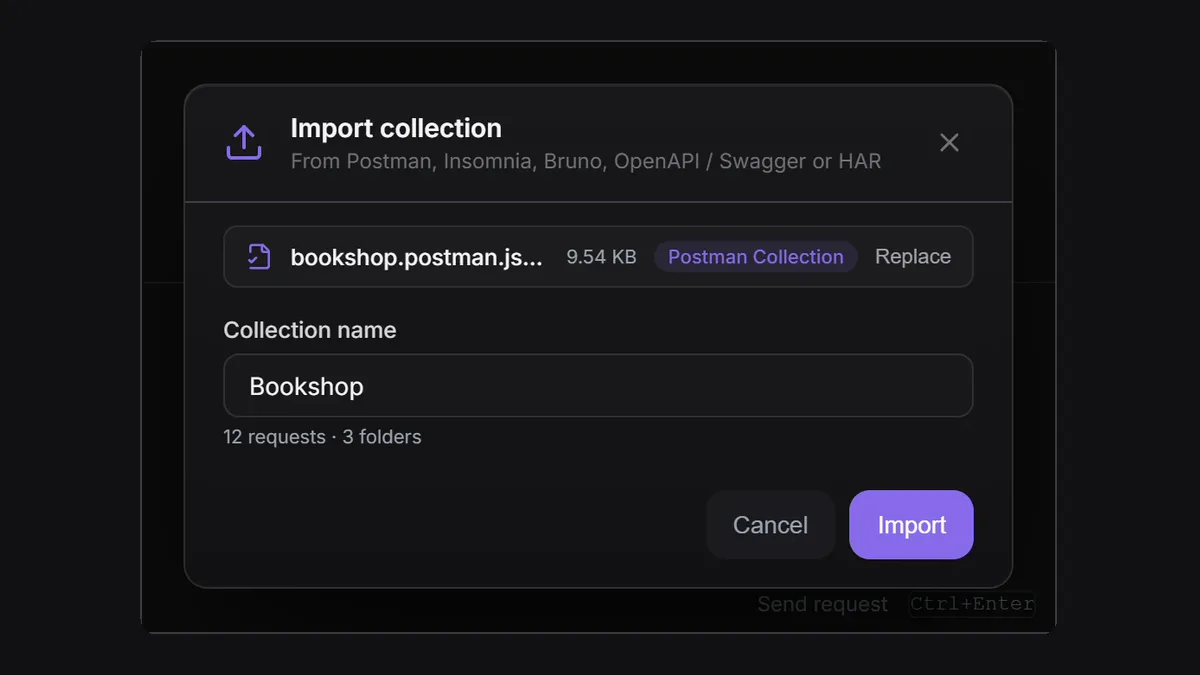
Export a Postman collection (v2.1) or an Insomnia export and drop it on Apiboo’s sidebar; from Bruno, drop the collection folder (.bru or YAML) on Apiboo’s Import collection dialog, or import a collection you exported from Bruno as JSON or OpenCollection YAML.
Download Apiboo for Windows, macOS or Linux at apiboo.com/download. It is free to start, with no card and no account: every tool runs on your own machine, and you only sign in when you want sync or a team.